

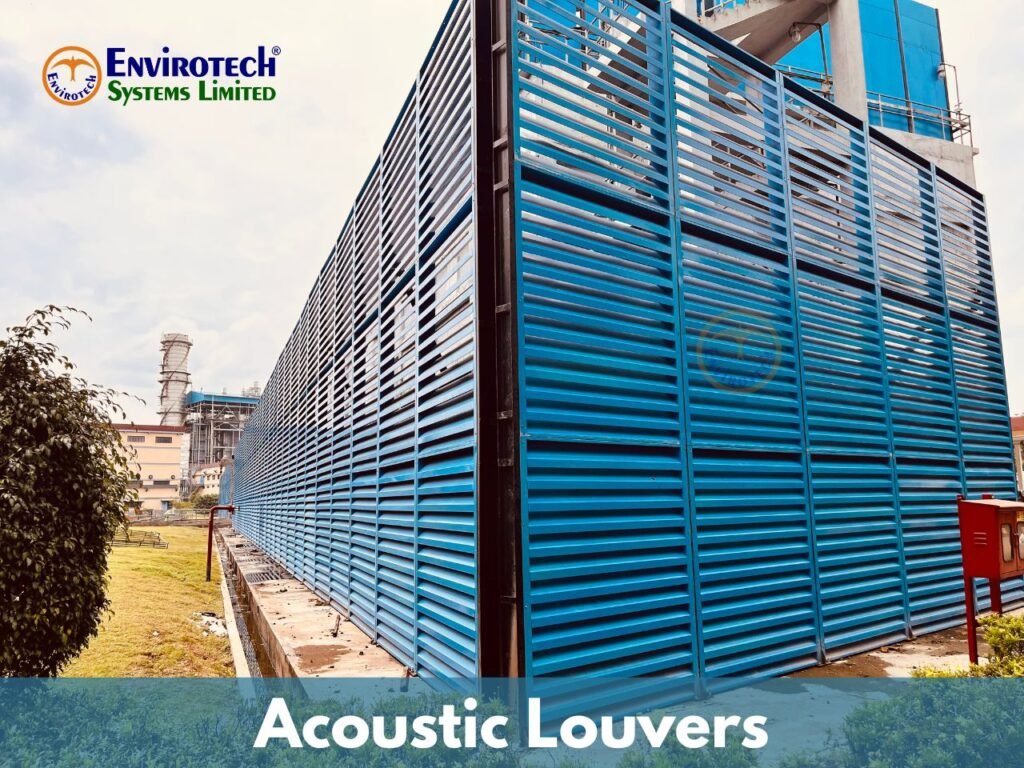
Envirotech Acoustic Louvers are sound-attenuating ventilation systems designed to reduce noise passing through air openings. Unlike standard ventilation louvers, they incorporate internal sound-absorbing materials and specially designed blades that block and absorb sound waves. Controlling noise while ensuring proper ventilation is a major challenge in industrial and commercial environments. Machinery such as generators, HVAC units, compressors, and ventilation systems produce high noise levels, yet they require continuous airflow for safe and efficient operation. An Acoustic Louver is a specially designed solution that addresses both these requirements effectively.
Definition of an Acoustic Louver
An Acoustic Louver is a sound-attenuating ventilation device engineered to reduce noise transmission through air openings. Unlike standard ventilation louvers, acoustic louvers are built with sound-absorbing cores and specially shaped blades that minimize noise escape while allowing fresh air to pass through. They are widely used in noise control systems where airflow cannot be compromised.
How Acoustic Louvers Reduce Noise
Envirotech Acoustic Louvers work by combining aerodynamic airflow design with acoustic absorption technology. As sound travels through the louver opening, it encounters internal blades lined with high-density acoustic insulation. These materials absorb sound energy and reduce reflected noise.
Additionally, the blade configuration forces sound waves to change direction multiple times, weakening them before they exit the louver. This design enables effective noise reduction, typically achieving attenuation levels between 10 dB and 35 dB, depending on the application and louver depth.
Construction and Materials
Acoustic louvers are manufactured using robust and weather-resistant materials to ensure long-term performance. Key construction elements include:
- Acoustic blades designed for optimal airflow and noise control
- Sound-absorbing infill, commonly mineral wool or glass wool
- Perforated metal sheets to enhance sound absorption
- Outer frames made from galvanized steel, aluminum, or stainless steel
- Protective accessories such as bird screens, rain hoods, and sand traps
These components work together to deliver durability, efficiency, and acoustic performance.
Applications of Acoustic Louvers
Due to their versatility, acoustic louvers are used across a wide range of industries and projects, including:
- DG set and generator enclosures
- HVAC and chiller plant rooms
- Compressor and blower rooms
- Industrial sheds and factories
- Commercial buildings and data centers
- Infrastructure and utility installations
They are especially valuable in locations where noise regulations must be strictly followed.
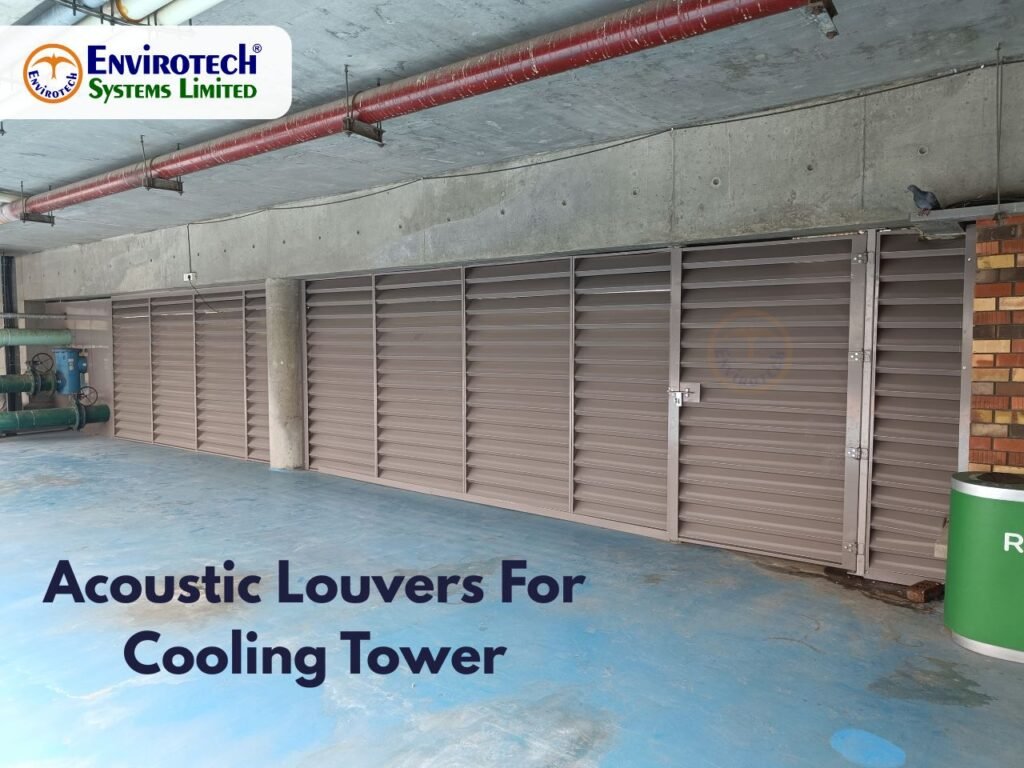
Advantages of Acoustic Louvers
Using acoustic louvers offers several important benefits:
- Reduced noise pollution without blocking ventilation
- Improved equipment cooling and airflow efficiency
- Strong and corrosion-resistant construction
- Customizable designs to meet specific noise and airflow requirements
- Compliance with environmental and workplace noise standards
- Importance of Acoustic Louvers in Modern Projects
With increasing focus on environmental responsibility and occupational safety, acoustic louvers have become an essential element in noise control planning. They help industries maintain operational efficiency while protecting nearby communities and workers from excessive noise exposure.
An Acoustic Louver is a practical and effective solution for managing noise in ventilated spaces. By allowing air to flow freely while significantly reducing sound levels, Acoustic Louvers play a vital role in modern industrial, commercial, and infrastructure projects. Their combination of performance, durability, and compliance makes them a key component in any professional noise control system.